
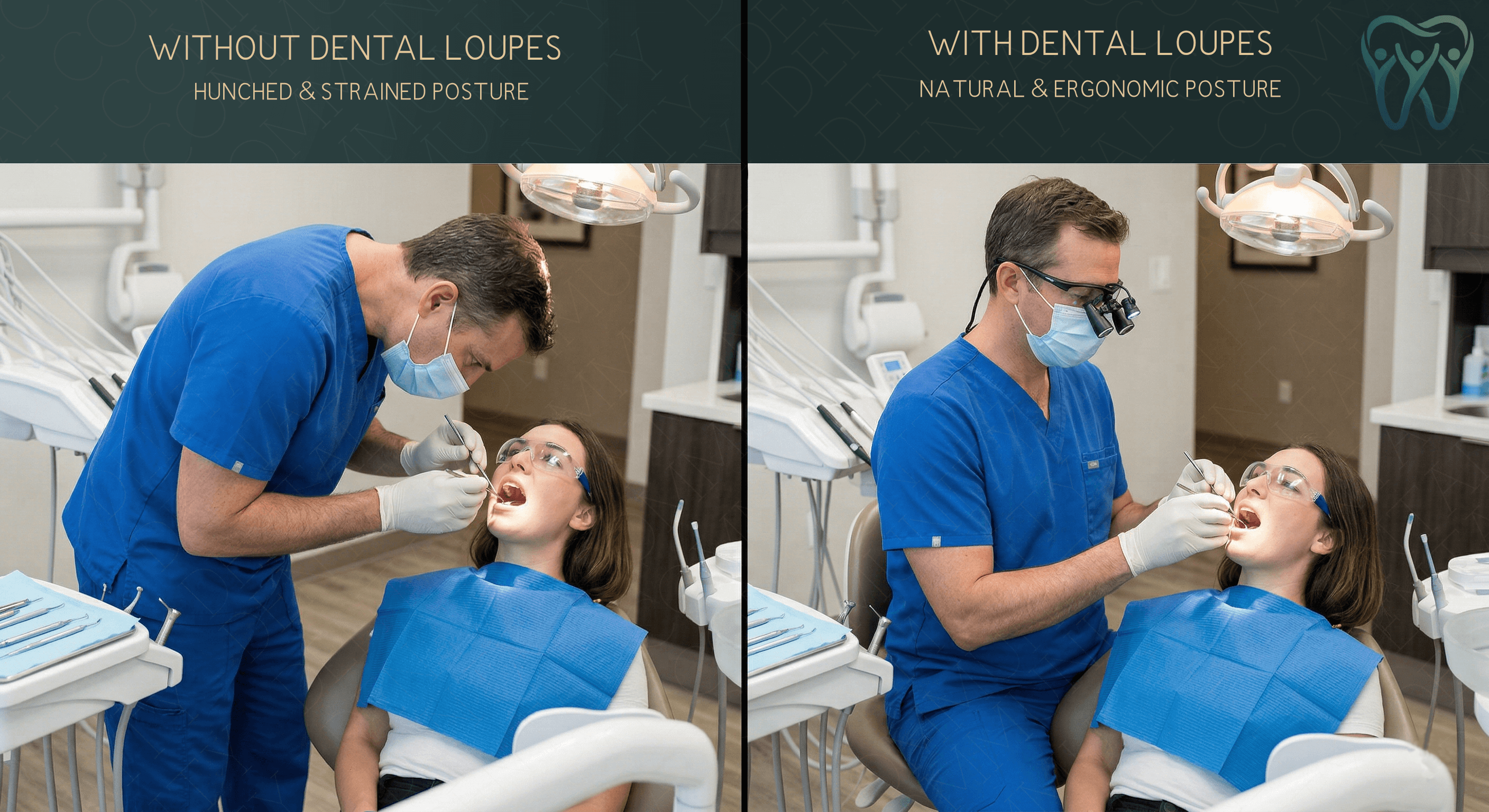
Modern dentistry is a micro-world where every millimeter is crucial. However, we often forget the main thing: a doctor's health is their primary capital. A dentist's career often ends not because of age, but because of chronic pain. Binocular loupes are exactly the instrument that ensures a doctor's "professional lifespan."
For Partners and Suppliers:The Georgian Dental Society is actively transitioning to high-tech working standards. Our platform unites professional dentists working in Georgia who are actively interested in premium quality optics and medical equipment.
If you represent leading optical brands (Admetec, Zeiss, Orascoptic, Univet, etc.), our platform is the best space to position your products. Unlock new opportunities with us! Join our B2B ecosystem and become part of the industry's development!
What Are Binocular Loupes and How Do They Work?
Binocular loupes are optical devices placed on a special frame (similar to glasses) that provide magnification of the working area.
This means the doctor can clearly see:
- Micro-cracks
- Small carious lesions
- Root canal entrances
- Precise preparation margins
...which are often completely invisible to the naked eye.
Why Is "Just Good Vision" No Longer Enough?
- The human eye cannot perceive all micro-details.
- Prolonged concentration causes severe eye fatigue.
- Small visual errors accumulate and ultimately affect the treatment result.
Loupes are not just an "assistant" — they are a precision-enhancing system.
Why Is Using Loupes Essential?
1. Precision = Quality
Loupes significantly increase detail perception, which directly impacts treatment outcomes. Better diagnostics: discovering problems at an early stage becomes much easier.
2. Ergonomics — "Insurance" for Your Spine
Over 80% of dentists complain of neck and back pain. Using loupes is a fundamental solution to this problem:
- Correct Working Posture: Optics force you to maintain a natural spinal position. You no longer have to bend excessively over the patient, sharply reducing the load on intervertebral discs.
- Vision Preservation: The human eye constantly tries to focus on small details, causing eye muscle fatigue (accommodation). High-quality optics take this load off.
- +15 Years of Career: An ergonomically working doctor maintains their ability to work and high productivity for much longer.
What Makes an "Ideal" Binocular Loupe?
When selecting suppliers or purchasing a product, it is important to pay attention to the following criteria:
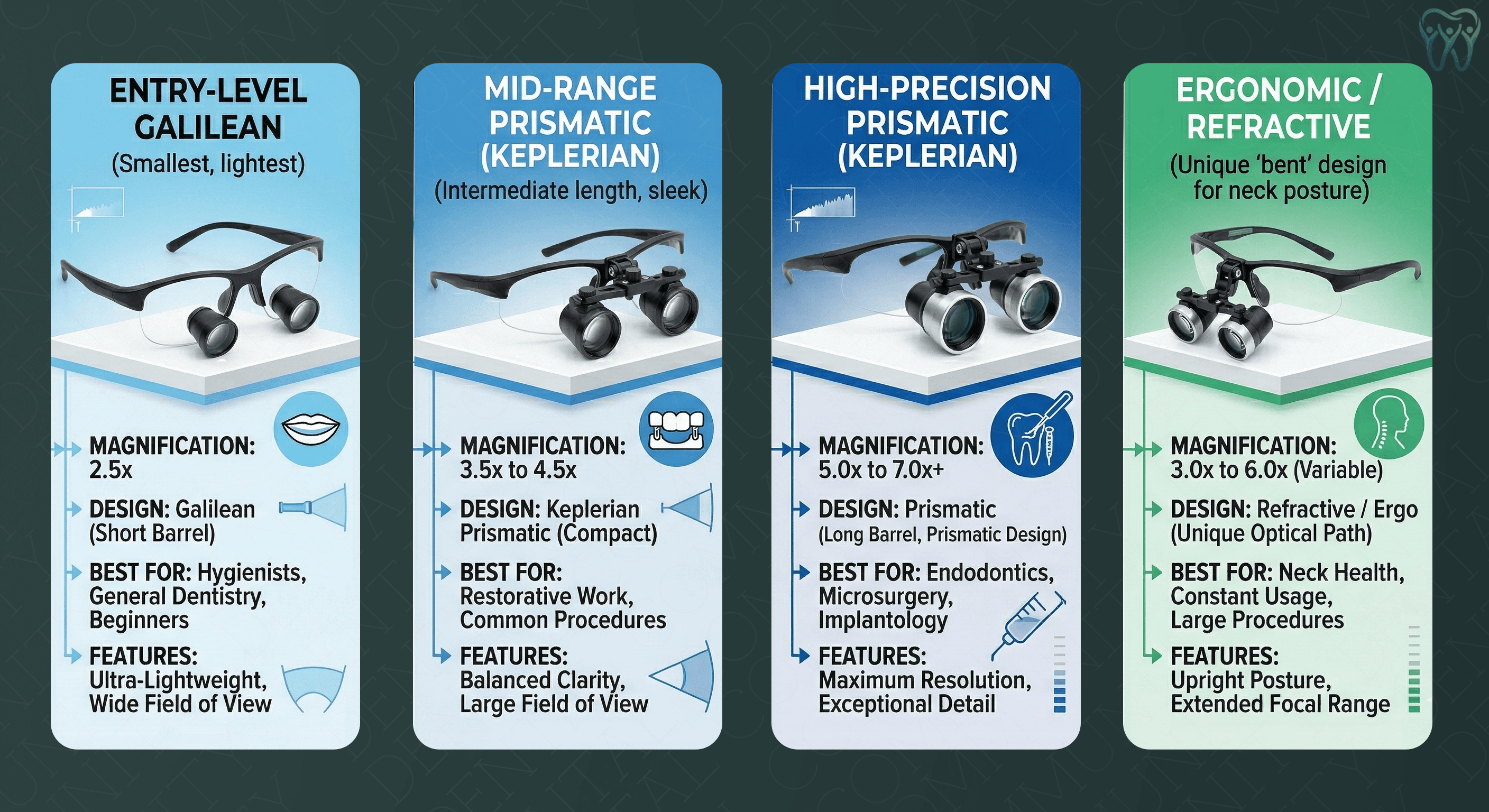
- Magnification Level: 2.5x - 3.0x is recommended for beginners, while 3.5x and higher is for complex orthopedic or endodontic work.
- Working Distance: This is individual. A good loupe must be precisely tailored to the doctor's height and arm length to ensure a natural posture.
- Field of View: The larger the field of view, the less the eye tires and the easier it is to orient inside the oral cavity.
- Weight: The modern trend leans toward ultra-light loupes (e.g., titanium or carbon frames) that minimize pressure on the nose.
- Illumination: A loupe without a light is only half the job. Coaxial (direct) LED illumination eliminates shadows where the clinic's overhead lamp cannot reach.
Ergonomic (Deflection) Loupes — A New Word in the Market
Today, "Ergo" (Deflection) loupes have appeared on the market. They refract the light beam at an angle, allowing the doctor to look straight ahead while their field of vision is directed downwards at the patient. This is a revolution that reduces neck tension to practically zero.
An Evidence-Based Approach
Modern studies confirm that using optical magnification is directly linked to improved clinical outcomes. When using loupes, the risk of iatrogenic errors—such as incomplete caries removal, missed micro-cracks, or incomplete canal preparation—is significantly reduced. In endodontics and micro-prosthetics especially, where micron-level precision is critical, optics are no longer a recommendation, but a standard.
Adaptation and Proper Implementation
Many doctors hesitate to use loupes initially due to discomfort. However, it's important to remember that this is an adaptation process that lasts an average of 1–2 weeks. A properly selected loupe quickly becomes part of a doctor's daily practice. Gradual implementation is recommended: first during relatively simple procedures, and later full-time across all clinical situations.
Economic Effect and Return on Investment (ROI)
Binocular loupes are not just a clinical tool — they are a financially justified investment. Higher precision reduces the number of redo-procedures, increases patient satisfaction, and strengthens the doctor's reputation. In practice, the cost of a high-quality loupe often fully pays for itself in a few months through increased efficiency and reduced errors.
Conclusion: Binocular loupes are not just a "microscope on glasses." They are an investment in yourself. The patient receives better quality, and the doctor gains health and a long, pain-free career.